

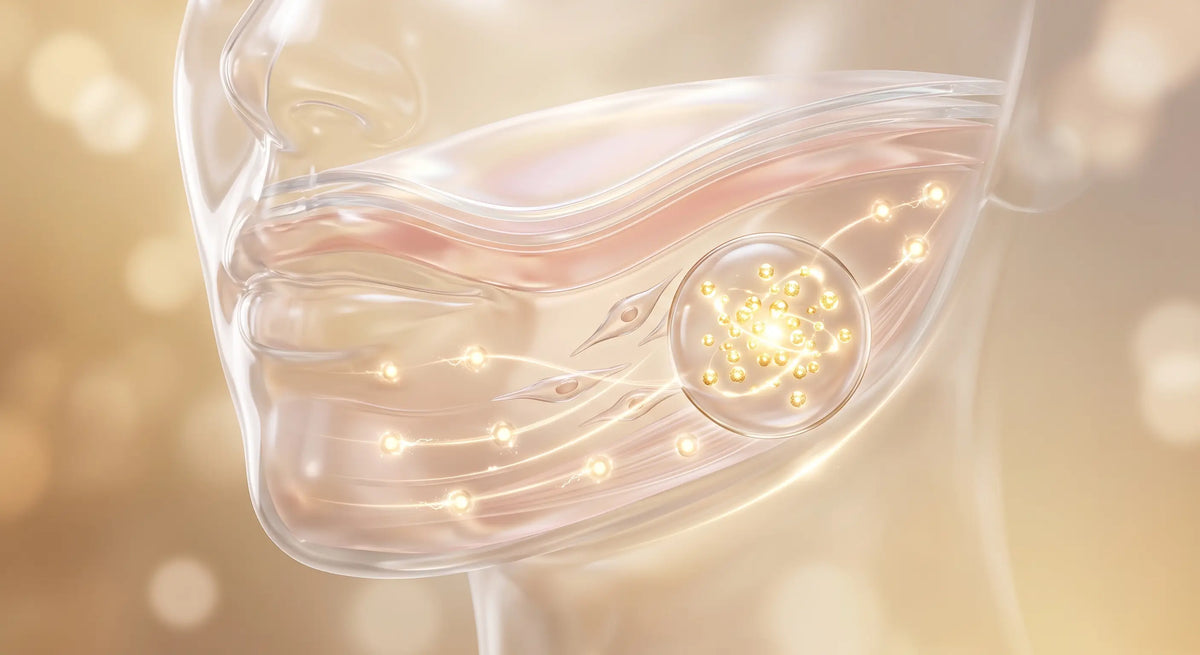
Facial toning devices all use small electrical currents, but they are not all doing the same thing — and the difference matters more than most marketing admits. Understanding which type of current your device delivers tells you which research actually applies to it, and what results are realistic.
How it works ?
The two categories. Electrical facial devices split into two genuinely different approaches:
Facial microcurrent uses extremely low currents, typically in the microampere range (millionths of an amp, often cited around 40–400 µA). These are close to the body's own natural bioelectric signals and are usually sub-sensory — you feel little or nothing, and there is no visible muscle contraction. The goal is cellular-level activity rather than muscle work.
EMS / NMES (electrical muscle stimulation / neuromuscular electrical stimulation) uses substantially stronger currents in the milliampere range — thousands of times higher. These are strong enough to depolarise motor nerves and produce a visible, palpable muscle contraction. The goal is genuine muscle conditioning, working the facial muscles much like resistance training works skeletal muscle.
Many consumer devices marketed as "microcurrent" actually deliver EMS-level stimulation, and vice versa. A simple test: if you can see or feel your muscles twitching, that is EMS, not sub-sensory microcurrent.
The proposed microcurrent mechanism. The biochemical rationale traces back to a foundational 1982 laboratory study, which reported that direct currents in the 10–1000 microampere range increased ATP concentrations (the molecule cells use for energy) in skin tissue, and stimulated amino-acid incorporation into proteins. The reasoning is that supplying skin cells with more available energy supports repair processes, including the fibroblast activity that maintains collagen. Contemporary reviews also propose effects on local blood flow and inflammatory signalling.
The EMS mechanism. This is more straightforward and better understood: repeated stimulated contractions of the facial muscles — particularly the zygomatic and other mid-face muscles — may increase muscle thickness and tone over time, the same adaptive response that any muscle shows to repeated loading. Because facial muscles attach directly to skin rather than only to bone, improved muscle tone may translate into a subtly more lifted appearance.
What the research shows
The strongest human trial is an EMS trial. Kavanagh et al. (Journal of Cosmetic Dermatology 2012;11(4):261–266) randomised 108 participants, with 56 using a neuromuscular electrical stimulation device five times weekly for 12 weeks and 52 acting as controls. The NMES group showed an 18.6% increase in zygomatic major muscle thickness versus baseline, with a between-group difference of P = 0.0001 at 12 weeks. On subjective measures, at least 80% of NMES users reported improved firmness, tone and lift, versus fewer than 5% of controls (P < 0.001). This is genuinely good evidence — but it is evidence for muscle-contracting stimulation, not for sub-sensory microcurrent.
The mechanistic foundation. Cheng et al. (Clinical Orthopaedics and Related Research 1982;171:264–272) established that currents in the microampere range raise ATP levels in skin tissue. It remains the single most-cited study in microcurrent marketing.
Contemporary review. A 2025 peer-reviewed narrative review (Jonik, Rothka & Cherin, Therapeutic Advances in Chronic Disease) surveys microcurrent's proposed mechanisms — supporting cellular repair, modulating inflammation, improving local blood flow and increasing ATP synthesis — and notes it does so without discomfort or muscle fatigue. It is a narrative review rather than a meta-analysis, so it maps the field rather than quantifying effect sizes.
Multi-technology home devices. Because microcurrent is often bundled with other technologies, several recent trials test it in combination. A 2025 randomised controlled trial (Bu et al., Journal of Cosmetic Dermatology) enrolled 90 volunteers aged 25–65 over four weeks using home devices combining radiofrequency, microcurrent and LED. A 2024 randomised split-face trial (Lasers in Medical Science, 36 Korean women, 8 weeks) tested a handheld device combining light, radiofrequency, microcurrent and ultrasound, finding significant improvements in hydration, elasticity, roughness, pore size and eye-wrinkle volume versus the control side. A smaller study of a combined RF-plus-microcurrent device found improvement in fine lines, tightness and brightness in 11 participants after six treatments. These support the combination — they cannot isolate what microcurrent contributed on its own.
Honest limitations
The headline study does not apply to gentle devices. This is the most important honest note on this page. The impressive 18.6% muscle-thickness figure comes from a device delivering visible muscle contractions. If a device is sub-sensory microcurrent, that number is not its evidence. Brands routinely blur this line; buyers deserve the distinction.
The ATP study was on rat skin. Cheng 1982 used excised rat tissue in a laboratory, not living human faces. It establishes a plausible biological mechanism; it does not demonstrate a visible cosmetic outcome. It is also over forty years old, and the field has not produced a definitive human replication for facial aesthetics.
A commonly quoted statistic is unreliable. The widely circulated claim that microcurrent increases ATP "by up to 500%" is a secondary-source figure. The original abstract confirms increased ATP concentrations across the tested current range but does not headline that specific percentage. Treat it as marketing shorthand rather than a citable result.
Effects are subtle and reversible. The best analogy is exercise. Benefits accumulate with repetition and recede when you stop — muscle tone is not permanent, and neither is this. Anyone expecting a surgical-style lift will be disappointed.
Rigorous evidence for at-home sub-sensory microcurrent specifically remains thin. Most well-designed trials use either stronger EMS devices or multi-technology combinations. That does not mean microcurrent does nothing; it means the honest position is "plausible mechanism, limited direct proof."
Using it safely
Conductive gel is mandatory, not optional. Microcurrent will not conduct meaningfully through dry skin. Use a water-based conductive gel generously and reapply if it dries mid-session — most disappointing results come from insufficient gel rather than a faulty device.
Technique. Move slowly. Work upward and outward, following the direction of the facial muscles: along the jawline toward the ear, up the cheek, outward across the forehead. Hold each position for a few seconds where the device instructs. Rushing defeats the purpose.
Frequency. Because the effect is cumulative and exercise-like, consistency beats intensity. Many protocols suggest five sessions weekly for an initial 8–12 week period, then a reduced maintenance schedule of two to three times weekly. Ongoing use is required to maintain results.
Timeline. Expect subtle changes from around four weeks, with the clearest results in trials measured at 12 weeks. Any immediately visible "lift" after a single session is largely temporary.
Who should avoid it. Do not use if you have a pacemaker, defibrillator or other implanted electronic device; if you have epilepsy; or if you are pregnant. Avoid over broken, inflamed or infected skin, over active cold sores, and over recent injectables without professional advice. Anyone with a metal implant in the treatment area should seek guidance first.
Frequently asked questions
What is the difference between microcurrent and EMS?
Current strength. Microcurrent uses microamperes and is usually imperceptible with no visible muscle contraction. EMS uses milliamperes and produces visible muscle twitching. They target different things — cellular activity versus muscle conditioning.
Does microcurrent actually work?
The mechanism is biologically plausible and the strongest trial in this space showed real, measurable muscle-thickness gains — but that trial used a muscle-contracting device. For gentle sub-sensory microcurrent specifically, the direct human evidence is limited. Expect subtle support rather than dramatic change.
How often should I use a microcurrent device?
Most protocols suggest around five sessions per week for the first 8–12 weeks, then two to three times weekly for maintenance. It works cumulatively, so regularity matters more than session length.
How long until I see results?
Subtle changes may appear around four weeks. The clearest trial results were measured at 12 weeks. Anything visible immediately after one session is temporary.
Do I have to use the gel?
Yes. Without a conductive medium the current cannot pass effectively into the skin, so the device is essentially doing nothing. This is the most common user error.
Can I use my regular serum instead of conductive gel?
Only if it is water-based and conductive. Oil-based products actively block conduction. Use a purpose-made conductive gel for the session and apply your serums afterwards.
Is microcurrent safe for everyone?
No. Avoid it if you have a pacemaker or other electronic implant, epilepsy, or are pregnant, and avoid use over broken or inflamed skin.
Will the results last if I stop?
No. Like muscle tone from exercise, the effect fades gradually once stimulation stops. Maintenance sessions are needed.
Can I combine microcurrent with radiofrequency or LED?
Many home devices do exactly this, and several trials tested such combinations with positive results. Follow your device's programme rather than stacking separate treatments in one sitting.