

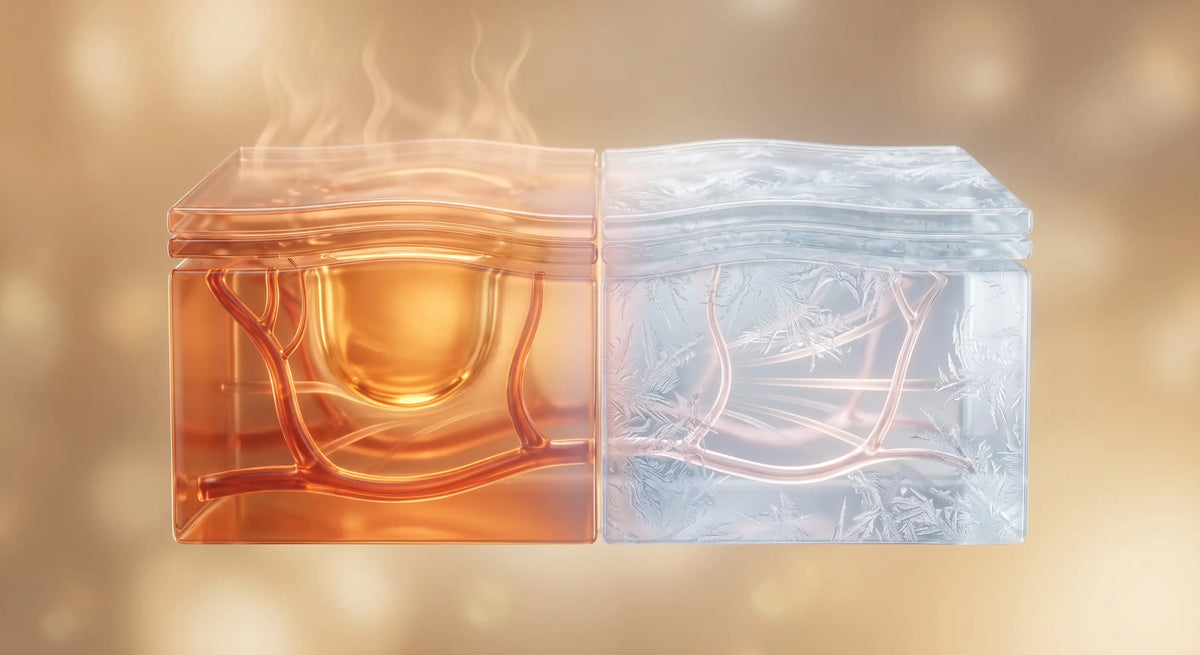
Temperature is one of the oldest tools in skincare, and it works in two opposite directions depending on what the skin needs. Warmth softens; cold calms. They're grouped on one page because that's how they're actually used — as complementary settings on the same device, chosen depending on whether you're dealing with a congested pore or visible redness and puffiness, rather than as competing options.
How it works ?
Warmth (≈40–42°C) works on a simple principle: sebum and sebum-like secretions aren't liquid at every temperature — when they solidify or thicken, they block the duct they should be flowing through. Heat lowers their viscosity, turning a semi-solid plug back toward something that can flow and clear naturally. The best-quantified version of this mechanism actually comes from ophthalmology, where warm compresses have been the clinical mainstay for blocked oil glands in the eyelids for over forty years — and the eyelid's meibomian glands are modified sebaceous glands, secreting a lipid substance through the same basic physics as facial pores. Research there found the melting point of blocked gland secretions sits around 34°C — notably higher than normal resting skin temperature, which is exactly why the material solidifies and blocks in the first place. Warming to 40°C substantially increases lipid disorder (the shift from solid toward flowing liquid), with a further 4°C pushing it to near-complete. Warmth also produces local vasodilation, increasing blood flow to the area, which contributes to the soothing sensation and to delivering repair activity to inflamed tissue. Timing matters as much as temperature: studies found at least four minutes of warm contact is needed to actually raise tissue temperature to the effective 40°C threshold — a quick pass with a warm cloth often never gets there.
Cooling, by contrast, works through vasoconstriction: cold exposure narrows the small blood vessels in the skin, reducing local blood flow. This is a reflex response, mediated partly through the sympathetic nervous system and partly through direct effects on vascular smooth muscle. Two visible consequences follow — less blood in superficial vessels means less visible redness, and reduced capillary pressure means less fluid pushed into surrounding tissue, which reduces swelling. Facial puffiness, especially the morning under-eye kind, is largely interstitial fluid that pooled while lying flat, so vasoconstriction plus the mild mechanical pressure of a compress helps shift that fluid — which is why the effect on puffiness is so immediate. Moderate cold also slows local cellular metabolism and dampens the inflammatory cascade that produces redness and swelling, the same principle behind icing a sprain, applied more gently here.
What the research shows
For warmth, the cleanest controlled data comes from a study of 20 patients (Olson, Korb & Greiner) that applied a compress at 40.0 ± 2.0°C to one side of the face-adjacent eyelid area while the other side received a room-temperature compress at 24.0 ± 1.0°C as a within-person control. Lipid layer thickness increased by more than 80% just five minutes after starting treatment, with a further 20% increase after 15 minutes — a genuinely clean demonstration that heat mobilises a blocked lipid secretion. A broader review of twenty trials found that all effective compresses reached 40°C, with moist-heat approaches producing the most reliable results and best user adherence. A 12-week randomised study of 134 patients found temperature-controlled masks outperformed improvised compresses on symptoms and gland function.
For facial sebum specifically, the classic controlled study (Cunliffe, Burton & Shuster, British Journal of Dermatology, 1970) found a highly significant relationship between skin temperature and sebum excretion rate, with changes on the order of 10% per 1°C, occurring within 90 minutes. A modern randomised crossover trial (Zhu et al., Environmental Research, 2025) exposed 30 healthy adults to 22°C versus 32°C for two hours and found sebum secretion significantly increased at the higher temperature, alongside raised inflammation markers.
For cold, a 2016 study (Khoshnevis et al., Journal of Biomechanical Engineering) examined six healthy subjects and found that localised cooling caused significant vasoconstriction that continued well beyond the active cooling period, even as skin temperature returned toward baseline — a hysteresis effect between temperature and blood perfusion, meaning the visual benefit outlasts the cooling itself. A related study evaluating four FDA-cleared cryotherapy units confirmed that cold-induced reductions in blood perfusion persist long after cooling stops, across different delivery methods. Dermatology literature more broadly recognises that short-term application of moderately cold temperature produces localised vasoconstriction, decreased cellular permeability, and decreased cellular metabolism, together dampening the inflammatory cascade.
Honest limitations
Warmth's most important correction is this: research consistently shows heat increases surface sebum, by roughly 10% per degree of temperature rise — not decreases it. So warmth is not an oil-control measure; its legitimate role is softening and mobilising the hardened contents of an already-blocked pore, a viscosity effect on existing material rather than a change in how much oil skin produces. Direct facial-acne trial evidence is also thinner than you'd expect — the rigorous temperature research comes from eyelid glands, and while the mechanism transfers logically to facial sebaceous glands, that's an inference rather than a demonstration; there's no large randomised trial showing warm compresses clear blind pimples specifically. The effect is also palliative and needs repetition — warming doesn't cure gland dysfunction, and the same realistic framing applies to facial congestion. Heat can also worsen some conditions: raised inflammation markers were observed in the 2025 heat study, and heat is a recognised trigger for rosacea and melasma. Improvised compresses are also poorly standardised — a towel from the tap cools within a minute or two and may never reach the effective threshold, so much of the "warm compresses don't work" experience is really a temperature-and-duration failure rather than a mechanism failure.
Cold's honesty check starts with where the research actually comes from — both key vasoconstriction studies examined limbs in a therapeutic cryotherapy setting, not facial cosmetics. The physiology transfers logically (blood vessels behave the same way everywhere), but this is extrapolation, and the specific cosmetic outcomes haven't been trialled to the same standard. Everything cold does is also temporary — no lasting change to skin structure, collagen, or pore size, just hours of managed appearance. And cold can genuinely injure skin if used carelessly: the same literature documenting cold's benefits warns that excessive or prolonged cold causes sustained ischaemia and cold injury. Melanocytes are particularly cold-sensitive, and hypopigmentation is the most commonly reported adverse effect of dermatological cold exposure — a real risk for deeper skin tones if ice is held directly on bare skin too long. It's also worth separating cosmetic cooling from clinical cryotherapy entirely: clinical cryotherapy uses liquid nitrogen at roughly −196°C to deliberately destroy tissue, a completely different process from a chilled roller or gel mask, and marketing that borrows the word "cryotherapy" for gentle cooling is borrowing credibility — and risk profile — it hasn't earned.
Using it safely
For warmth: target roughly 40–42°C — comfortably warm, never hot; if it stings or makes you flinch, it's too hot and risks a burn. Give it enough time, at least four to five minutes of sustained contact, re-warming a damp cloth every couple of minutes as it cools. Moist heat outperforms dry heat consistently in the research. Never squeeze or pick afterward — this is where lasting damage happens; the point of warming is to let a pore clear on its own, and forcing it drives material deeper and extends inflammation. Use a freshly clean cloth every time. Follow with a light, non-comedogenic moisturiser, and skip heavy occlusive products right after, since heat temporarily raises sebum output. Avoid warmth on rosacea-prone, actively inflamed, or sunburned skin.
For cold: never apply ice directly to bare skin — always use a barrier, whether a clean cloth or the device's intended contact surface. Keep it brief; a few minutes is enough, and short repeated applications are safer than one long one. If skin goes numb or white, stop immediately. Keep a roller or chilled tool moving rather than resting it in one place. Mornings suit de-puffing best, since fluid accumulates overnight. Clean tools between uses. Avoid cold therapy if you have cold urticaria, Raynaud's phenomenon, or any condition worsened by cold exposure, and take particular care with deeper skin tones given the pigmentation risk.
Together, a common and effective sequence is warmth first — to soften and loosen a congested area — followed by brief cooling to calm the skin and settle any redness the warmth brought to the surface. Prep with heat, finish with cold.
Frequently asked questions
Does a warm compress reduce oily skin?
No — the opposite. Research consistently shows warming skin increases sebum output, by roughly 10% per degree of temperature rise. Warmth helps soften and mobilise the hardened contents of a blocked pore; it isn't an oil-control treatment.
How hot should a warm compress be, and for how long?
Around 40–42°C, comfortably warm and never hot, for at least four to five minutes. Studies found tissue needs about four minutes of contact to actually reach the effective temperature — a quick pass with a warm cloth often achieves nothing.
Will a warm compress get rid of a blind pimple?
It may help soften the contents so the blockage clears naturally, and it usually relieves pressure and tenderness. There's no rigorous trial proving it clears them outright, and — critically — never squeeze afterward, since forcing it drives material deeper and extends inflammation.
How long does the cold de-puffing effect last?
Longer than the cooling itself — research found vasoconstriction persists after skin temperature returns toward normal, so expect the visible benefit to last a few hours, though it's temporary either way.
Can ice damage your skin?
Yes, if used carelessly. Prolonged direct ice contact can cause cold injury, and melanocytes are particularly cold-sensitive, making hypopigmentation the most commonly reported adverse effect. Always use a barrier and keep sessions short.
Is an ice facial the same as cryotherapy?
No. Clinical cryotherapy uses liquid nitrogen at around −196°C to destroy tissue and is a medical procedure. Cosmetic cooling is far gentler and works through temporary vasoconstriction — the terms get blurred in marketing, but the evidence and risk profile don't transfer between them.
Warm or cold — which for a pimple?
Depends on the spot. Warmth suits deep, congested, un-headed blemishes where softening the blockage helps. Cold suits red, swollen, inflamed lesions where calming visible redness is the goal. Many routines use warmth first, then cold to settle the area afterward.
Can I use warm or cold compresses if I have rosacea?
Warmth generally isn't advisable — heat is a well-recognised rosacea trigger and can worsen flushing. Cold is usually better tolerated and can help calm visible redness, though individual response varies.
How often can I use each?
Warmth: once or twice daily is the pattern used in the clinical literature. Cold: brief daily use is generally well tolerated. For both, duration and intensity matter more than frequency — more isn't better.