

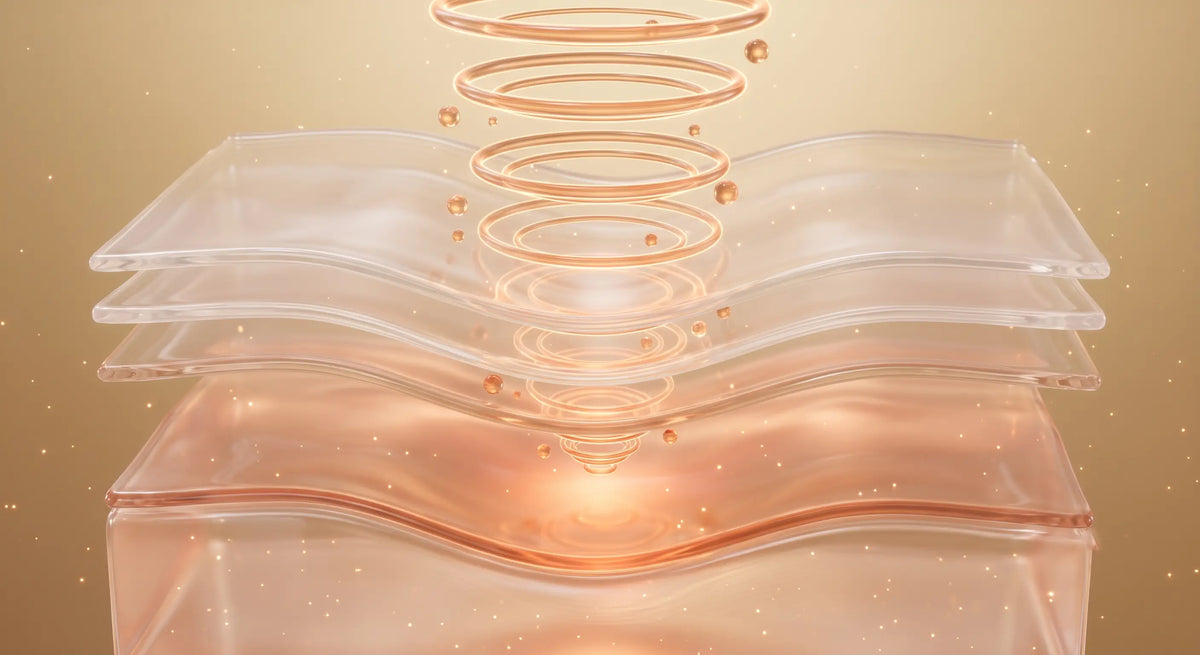
Radiofrequency (RF) is one of the few at-home skincare technologies with a genuinely substantial clinical literature behind it — including randomised trials run specifically on home-use devices rather than clinic machines. It works by gently warming the deeper layers of the skin, and studies suggest that controlled warmth may help support firmer-looking, smoother skin over a course of consistent use.
This page covers how RF actually works, what the research shows (including where it falls short), what results are realistic, and how to use an RF device safely.
How it works ?
Radiofrequency delivers a high-frequency alternating electrical current — typically around 1 MHz in home devices — into the skin. Unlike light-based technologies, RF is not absorbed by a specific pigment or chromophore. Instead, it meets the skin's natural electrical resistance (impedance), and that resistance converts the energy into gentle, controlled heat within the tissue itself.
The two-stage mechanism. The warming is thought to work in two phases:
Immediate contraction. When collagen fibres reach roughly 40–42°C, the triple-helix structure of the collagen molecule partially unwinds and contracts. This produces a modest, immediate tightening — the "instant" effect people sometimes notice after a session, which fades within days.
Delayed remodelling. The more meaningful change happens over the following weeks. Controlled warming is thought to signal fibroblasts (the collagen-producing cells of the dermis) to increase activity, prompting the skin's natural remodelling process and new collagen formation — a process called neocollagenesis. This is why RF results build gradually rather than appearing overnight.
Why the surface stays comfortable. Because heat is generated by the tissue's own resistance rather than transferred from a hot plate, energy can reach the dermis (roughly 1–3 mm deep in home devices) while the skin surface remains at a comfortable temperature. Many devices also cool the contact surface to protect the epidermis.
Monopolar vs bipolar vs multipolar. Clinic devices are often monopolar, sending current from a single electrode deep through the tissue to a return pad — this reaches deepest but requires professional control. Most home devices are bipolar or multipolar, with the current travelling between two or more closely spaced electrodes on the handpiece itself. This limits depth, which is precisely what makes home devices safer, but also means gentler results.
The evidence
RF has one of the better evidence bases in at-home skincare, and importantly, several trials tested actual home-use devices rather than extrapolating from clinic equipment.
Home-device randomised trials. A 2022 randomised, controlled, split-face trial (Shu et al., Dermatology and Therapy 12(4):871–883) enrolled 33 women aged 35–60 with crow's feet, running for 12 weeks with five repeated measurements at baseline, 2, 4, 8 and 12 weeks. Each participant used a home RF device on one side of the face and a marketed anti-ageing cosmetic on the other. The RF side showed statistically significant improvements in wrinkles, skin radiance and colour (p < 0.05) compared with the cosmetic-treated side — a useful comparison because it benchmarks the device against something people already use.
A 2024 open-label intraindividual controlled trial (Ai et al., Journal of Cosmetic Dermatology) tested a portable home RF device in 22 women aged 25–60 with Fitzpatrick skin types III–IV and mild-to-moderate facial wrinkles. Three weeks after the fourth treatment, 21 of 22 participants (95.5%) reached the primary endpoint of at least 25% improvement on the Fitzpatrick Wrinkle Classification Scale versus baseline.
An earlier home-use study (Gold et al., Journal of Cosmetic Dermatology 2017;16(1):95–102) had 33 subjects self-treat the periorbital area 21 times over six weeks using a combined RF-and-light device. Blinded independent assessment by three dermatologists found an average reduction of 1.49 Fitzpatrick scores (p < 0.001).
Multi-energy home devices. A 2024 prospective randomised split-face trial (Lasers in Medical Science) enrolled 36 Korean women using a handheld device combining low-level light, low-dose radiofrequency, microcurrent and low-intensity ultrasound. After 8 weeks, skin hydration, elasticity, roughness, pore size and eye-wrinkle volume all improved significantly versus both baseline and the untreated control side — relevant context for multi-technology devices, though it cannot isolate RF's individual contribution.
Clinic-grade evidence and reviews. A 2025 randomised controlled study (Wang et al., Lasers in Surgery and Medicine 57(3):259–264) compared a novel monopolar RF device against the established Thermage CPT system in 40 participants, with imaging follow-up at 1, 3 and 6 months, and concluded the newer device was non-inferior. A larger multicentre non-inferiority trial across four hospitals randomised 212 subjects aged 30–60 with Fitzpatrick types II–V. A 2021 systematic review of RF for face and neck rejuvenation (Austin et al., PMID 34923652) concluded the literature showed lifting effects, improved elasticity and wrinkle reduction, alongside histological evidence of new collagen formation. Recent reviews in World Journal of Clinical Cases (2025) and Health Science Reports (2025) summarise the same core mechanism of thermally driven collagen contraction followed by regeneration.
Honest limitations
Home devices are deliberately weaker. This is the single most important caveat. Clinic RF systems reach higher energies and deeper tissue than any consumer device is permitted to. Home RF is calibrated for safety, which necessarily means subtler results and a longer timeline. Marketing that shows clinic-level before-and-afters for a home device is misleading.
Results require maintenance. RF does not permanently reset the skin. The remodelling effect depends on continued stimulation; when use stops, the skin gradually returns toward its previous state as natural collagen turnover continues. Realistically this is an ongoing routine, not a course of treatment with a finish line.
Study sizes are small and some funding is commercial. The home-device trials cited above enrolled 22–36 participants each. Several were industry-affiliated or single-centre. That is normal for cosmetic-device research, but it means effect sizes should be read as indicative rather than precise.
Timeline expectations. Any immediate tightening you notice after a session is temporary. Meaningful change typically becomes visible around 4–8 weeks of consistent use, with collagen remodelling generally peaking around 12 weeks. If nothing has changed by then, the device is unlikely to suddenly start working.
RF does not replace surgery or injectables. For significant skin laxity, RF may soften the appearance but will not lift structurally. Being honest about this upfront prevents disappointment.
Using it safely
Preparation. Start with clean, dry skin, then apply a generous layer of the recommended conductive glide gel. RF needs that gel to distribute energy evenly — using it on dry skin or with an ordinary moisturiser risks uneven heating and hot spots.
Technique. Keep the device continuously moving in slow, overlapping passes. Never let the handpiece dwell in one spot. Work in sections (one cheek, then the other, then jawline) and follow the device's recommended time per zone. The sensation should be pleasantly warm, never hot or stinging — if it becomes uncomfortable, add more gel or reduce the intensity.
Frequency. Most home protocols suggest two to three sessions per week rather than daily use, giving tissue time to respond between sessions. More is not better with RF.
Aftercare. Apply a hydrating serum or moisturiser afterwards, and use daily broad-spectrum sunscreen — warmed skin benefits from protection, and sun exposure works directly against any firmness goal.
Who should avoid it. Do not use RF if you have a pacemaker, defibrillator or other implanted electronic device; if you are pregnant; over metal implants or permanent dermal fillers without professional advice; over active infections, open wounds, eczema or sunburn; or over areas treated with injectables in the previous two weeks. Anyone with a history of melasma should introduce heat-based treatments cautiously, as heat can be a pigmentation trigger.
Frequently asked questions
How long until I see results from at-home RF?
Most trials measure meaningful change at 4–8 weeks of consistent use, with peak collagen remodelling around 12 weeks. Any tightening you notice immediately after a session is temporary surface effect, not the real result.
Is at-home RF as good as clinic RF?
No, and it is not designed to be. Home devices operate at lower energies for safety reasons. They may support gradual improvement in firmness and texture, but clinic systems reach deeper and produce more pronounced change in fewer sessions.
How often should I use an RF device?
Typically two to three times weekly, following the manufacturer's protocol. Daily use is not more effective and may irritate the skin.
Does RF hurt?
It should not. The sensation is warm and generally comfortable. Pain or stinging usually means insufficient gel or too high an intensity setting.
Can I use RF with retinol or acids?
Not in the same session. Apply RF to clean skin with conductive gel, and keep actives for a different time of day or an off day, since heat can amplify irritation.
Can I use RF if I have fillers or Botox?
Consult the practitioner who administered them first. Heat may affect some filler materials, and most guidance suggests waiting at least two weeks after injectables.
Does RF work on the neck and jawline?
Many home devices are cleared for the lower face and neck, which are common areas of concern. Follow your device's specific guidance and avoid the thyroid area.
Will results disappear if I stop?
Gradually, yes. Collagen turnover continues naturally, so maintenance sessions are needed to sustain the effect.